
Wiretap & Battering RAM: TEE Security, Practical Uses, and the Future of Hybrid Privacy


This article is based on insights from a webinar with Trail of Bits: After Wiretap & Battering RAM: What Changes for TEE-Based Blockchain Infrastructure. Watch the recording.
Recent disclosures around the Wiretap and Battering RAM attacks have highlighted the practical limits of confidential computing when attackers have physical access to hardware running TDX or SEV-SNP. While these findings attracted headlines, they largely confirm what Intel and AMD have stated for years: physical attacks are out of scope for modern TEEs and will not be patched. For teams building privacy-preserving blockchain or data systems, this raises an important question: what role should TEEs play going forward?
Applied Blockchain’s view, shaped by more than five years working with TEEs and deep experience across ZKP, MPC, and FHE, is that: TEEs remain the strongest and most practical entry point for privacy-preserving computation today.
They offer immediate, general-purpose functionality; support real applications; and enable flexible developer workflows that alternative privacy technologies cannot yet match. Over time, maturing technologies such as ZKP, MPC, and FHE can be layered in to strengthen or extend privacy guarantees as needed. A hybrid, modular architecture, starting with TEEs, is the direction the industry is moving toward.
This article summarises Applied Blockchain’s perspective as a builder applying TEEs in production systems, and explains how the security findings fit into a realistic, forward-looking privacy strategy.
How Wiretap and Battering RAM Attacks Work
Recent physical attacks against TEE implementations, known as "Wiretap" and "Battering RAM", have demonstrated that attackers with physical access to machines running Intel TDX and AMD SEV-SNP can potentially extract secrets from running enclaves. These attacks work by exploiting the deterministic nature of in-place memory encryption used by these systems, allowing observers to build ciphertext dictionaries and correlate memory contents over time.
However, there's a crucial detail that often gets lost in the headlines: these physical attacks were always explicitly out of scope for Intel and AMD's threat models. Both manufacturers have excluded physical attacks from their threat models:
“Such attacks are outside the scope of the boundary of protection offered by Advanced Encryption Standard-XEX-based Tweaked Codebook Mode with Ciphertext Stealing (AES-XTS) based memory encryption, as originally stated in the 2021 Intel publication Supporting Intel® SGX on Multi-socket Platforms”
– Intel
“Physical attacks such as VFI fall outside the scope of the threat model of affected AMD products.”
– AMD
Physical Attack Limitations of TEE Security
Understanding how these attacks work is essential for making informed architectural decisions. When designing TEE-based systems, knowing the attack surface helps determine which trust assumptions are reasonable and where additional security layers are needed. The technical mechanics reveal not just what's vulnerable, but why certain deployment patterns provide better protection than others.
As such, the attacks point to two limitations of TEE security:
- A malicious actor with physical access to the machine can access runtime data.
- Remote attestations cannot prove a malicious actor with physical access to the machine doesn’t have access to runtime data.
As mentioned above though, these factors have always been the case. The recent attacks moved these vulnerabilities from theoretical to practical. Anyone building with assumptions that TEEs protected against physical attacks was operating under false assumptions from the start. Furthermore, these limitations do not diminish the value of TEEs as a practical foundation for privacy-preserving architectures today. Instead, they remind teams to deploy TEEs with the correct assumptions and use them as part of a layered approach.
TEE Security Benefits That Remain Intact
Despite these findings, TEEs remain valuable for privacy-preserving systems:
- Protection from malicious workload providers: When using a trusted third-party host, an application developer cannot access the data, as long as the TEE workload itself is solid.
- Protection from host employees: Staff within a host organization who have remote access to machines but lack physical access still cannot access data running in enclaves.
- This matters because host organizations, such as cloud providers, consist of many actors with varying access levels. Many employees may have system administrator access, but far fewer have physical access to machines. Physical attacks are also deliberate and difficult to execute without detection.
- Independent verification: Remote attestation can still verify that the workload provider cannot access the data.
These benefits are why TEEs continue to be used as the starting point for privacy systems, providing immediate functionality while leaving room to integrate additional privacy technologies as they mature.
TEEs continue to fulfill their original security promise when deployed with accurate understanding of their scope and limitations. For teams building on TEEs with proper awareness of these boundaries, the core value proposition remains unchanged.
Physical Attacks and Blockchain TEE Privacy: What to Know
The impact for privacy in blockchain systems is that TEE attestation alone is not sufficient for sharing data with untrusted third parties.
For example, a completely permissionless blockchain system relying on a TEE to protect the data e.g. running a version of Zcash that instead of using ZKP, uses TEEs, and anyone can run a node.
That application is not considered secure because only one malicious peer is needed to extract the data, highlighting why permissioned operators are essential.
What's required now is:
- Node operators must be permissioned
- The host infrastructure must be somewhat trusted
- The node operator and host should be split entities
Applied Blockchain follows this principle with its TEE-backed Layer 2, Silent Data, by deploying on third-party infrastructure rather than self-hosting. This separation ensures the company can credibly claim that it cannot access client data, because it lacks physical access to the hosting environment.
TEEs vs. ZKP, MPC, and FHE for Privacy
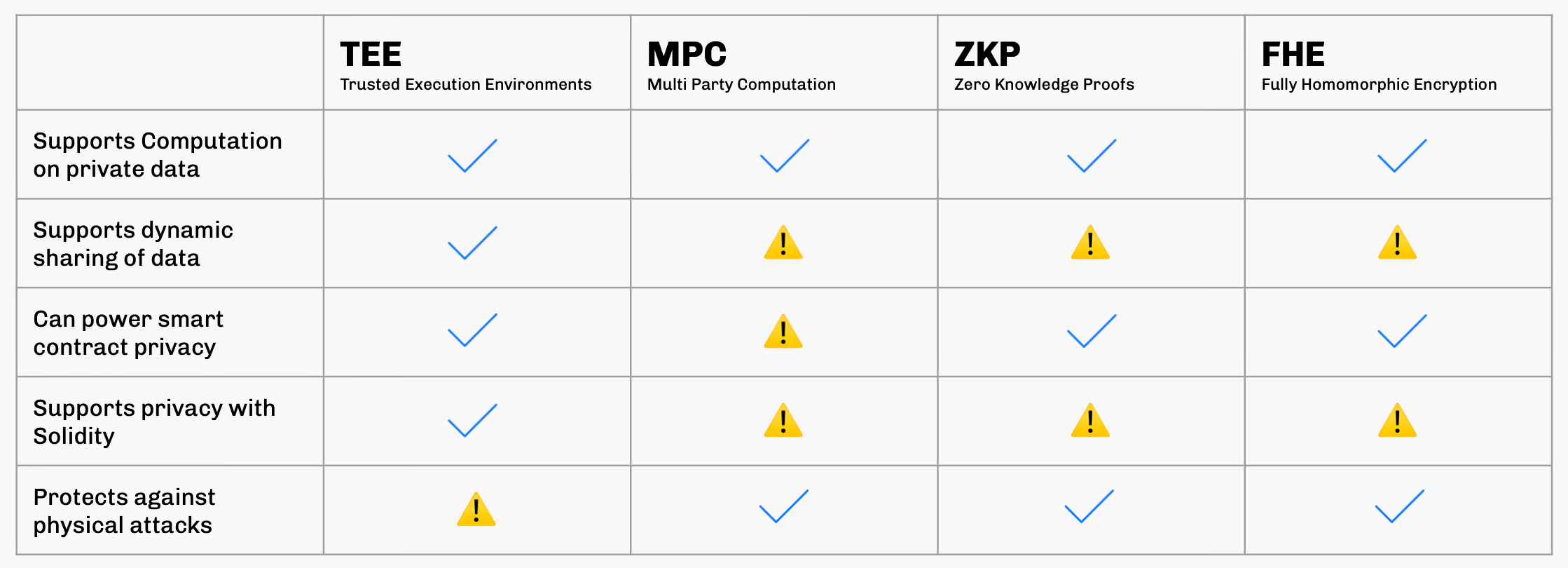
Applied Blockchain arrived at TEEs after extensive exploration of other privacy technologies including zero-knowledge proofs (ZKP), multi-party computation (MPC), and fully homomorphic encryption (FHE). Each has its place, but TEEs offer unique advantages.
All of these are built to:
- Support computation of private data
- Have data remain private and be able to do computation on that data
What makes TEEs compelling is that within the enclave, developers can work with data exactly as they would with plaintext data, even though it's encrypted from the outside. This enables use cases that other technologies struggle with:
- Dynamic data sharing: Sharing subsets of historical data or mixed datasets from multiple parties. FHE, ZKP, and MPC aren't designed to solve these use cases.
- Smart contract privacy: While MPC isn't well-suited for this, and ZKP/FHE have limitations, TEEs can power private smart contracts effectively
- Developer accessibility: TEEs allow privacy to be abstracted within Solidity without requiring developers to write circuits or develop bespoke MPC applications
This is why Applied Blockchain uses TEEs as the foundation for Silent Data. TEEs give broad functionality today; ZKP, MPC, and FHE can be layered in over time as they mature and become more performant.
Building Secure Systems with TEEs
These recent findings do not fundamentally change the TEE security model. TEEs still fulfill their original premise when deployed with the correct assumptions. The shift has been from theoretical vulnerabilities to practical demonstrations, but those vulnerabilities were always acknowledged.
The key is understanding what TEEs do and don't protect against, and architecting systems accordingly. With proper permissioning, trusted hosting partners, and separation between developers and hosts, TEEs remain a powerful tool for privacy-preserving blockchain infrastructure.
For organizations considering TEE-based solutions, the question isn't whether TEEs are "broken," but whether their threat model aligns with what TEEs actually provide. For many blockchain privacy use cases, they remain the most practical solution available.
Related Resources
- Trail of Bits x Applied Blockchain – After Wiretap & Battering RAM: What Changes for TEE-Based Blockchain Infrastructure. Watch the webinar recording.
Transcript




.svg)